Learning games & Explorations
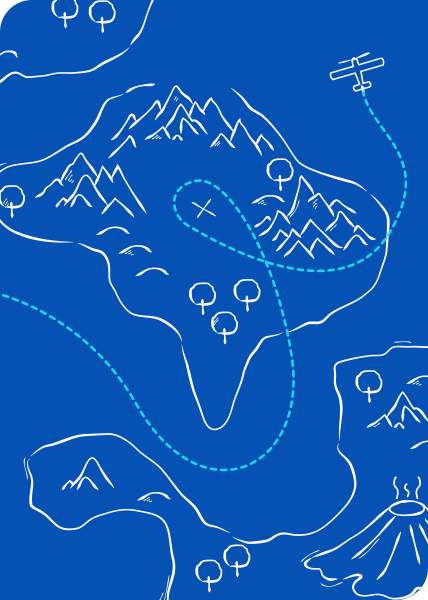
When you transform abstract concepts into tangible explorations and theoretical knowledge into real-world problem-solving, you put learners in the driver’s seat and let them take control of their learning. As they manipulate variables in a physics simulation, dissect virtual specimens in a biology lab, or navigate branching scenarios in a business ethics module, they're not just consuming content. They're actively constructing understanding. This is where engagement meets effectiveness, where curiosity sparks deeper learning.
We build interactive content that does more than engage; it accelerates and amplifies learning. Whether it's an open-ended exploration that sparks curiosity, a guided simulation that builds procedural fluency, or a scenario-based challenge that develops critical thinking, every interactive element serves a clear learning purpose. We design for the full spectrum of learner needs from discovery through mastery to authentic application.
From LTI and SCORM-compliant modules to xAPI-enabled activities, our interactive content integrates smoothly with Canvas, Moodle, Blackboard, and proprietary or custom platforms. Every experience is built to WCAG standards, responsive across devices, and optimized for the technical requirements of modern educational publishing. We help you create products that don't just look impressive, they deliver measurable learning outcomes and give your titles a competitive edge in crowded markets.
Discovery & Inquiry
Learning starts with questions, not answers.
Discovery-based experiences let learners explore phenomena, test hypotheses, and uncover patterns on their own terms, building the kind of deep conceptual understanding that lecture-based instruction can't match. These open-ended environments are particularly powerful for STEM subjects, where learners need to develop scientific reasoning and problem-solving skills alongside content knowledge. These experiences are built with instructional scaffolding that guides without intrusion, hints that appear when learners are stuck, data visualization tools that make patterns visible, and reflection prompts that consolidate learning.
- Open-Ended Explorations give learners agency to investigate without predetermined pathways. Learners might adjust parameters in an ecosystem model to see how predator-prey relationships shift, manipulate geometric transformations to discover properties of symmetry, or explore cause-and-effect relationships in social sciences. We design with multiple entry points and discovery paths so learners at different readiness levels can engage productively.
- Virtual Labs bring laboratory experiences to any device, no equipment costs, no safety concerns, no scheduling constraints. Learners can titrate acids, measure reaction rates, dissect anatomical specimens, or analyze geological samples with realistic instrumentation and infinite repeatability. We build to support both guided protocols and open investigation modes, including built-in data collection, and generate exportable data sets for analysis.

Discovery & Inquiry
Learning starts with questions, not answers.
Discovery-based experiences let learners explore phenomena, test hypotheses, and uncover patterns on their own terms, building the kind of deep conceptual understanding that lecture-based instruction can't match. These open-ended environments are particularly powerful for STEM subjects, where learners need to develop scientific reasoning and problem-solving skills alongside content knowledge. These experiences are built with instructional scaffolding that guides without intrusion, hints that appear when learners are stuck, data visualization tools that make patterns visible, and reflection prompts that consolidate learning.


Guided Learning & Concept Building
FROM ABSTRACT TO CONCRETE, ONE STEP AT A TIME.
Guided experiences scaffold complex concepts into manageable steps, letting learners build understanding progressively. Visual representations and interactive manipulation make abstract ideas tangible, whether it's algebraic thinking, molecular structures, or historical causation. We design these experiences to reveal relationships, demonstrate processes, and support sense-making through direct interaction.
-
Guided Explorations provide structured pathways through challenging content with strategic checkpoints and embedded feedback. Learners might work through multi-step proofs in geometry, explore the water cycle with guided observations, or investigate economic principles through controlled scenarios. The guidance adapts to learner responses, offering support when needed while maintaining productive challenge.
-
Interactive Diagrams and Data Visualization transform static images into exploration tools. Learners can rotate molecular models to understand bonding, manipulate supply-demand curves to see market effects, zoom into anatomical systems to examine organ relationships, or adjust historical timeline filters to analyze patterns. These tools help learners see connections that traditional textbook diagrams can't convey.
Guided Learning & Concept Building
FROM ABSTRACT TO CONCRETE, ONE STEP AT A TIME.
Guided experiences scaffold complex concepts into manageable steps, letting learners build understanding progressively. Visual representations and interactive manipulation make abstract ideas tangible, whether it's algebraic thinking, molecular structures, or historical causation. We design these experiences to reveal relationships, demonstrate processes, and support sense-making through direct interaction.
Guided Explorations provide structured pathways through challenging content with strategic checkpoints and embedded feedback. Learners might work through multi-step proofs in geometry, explore the water cycle with guided observations, or investigate economic principles through controlled scenarios. The guidance adapts to learner responses, offering support when needed while maintaining productive challenge.
Interactive Diagrams and Data Visualization transform static images into exploration tools. Learners can rotate molecular models to understand bonding, manipulate supply-demand curves to see market effects, zoom into anatomical systems to examine organ relationships, or adjust historical timeline filters to analyze patterns. These tools help learners see connections that traditional textbook diagrams can't convey.

Guided Explorations provide structured pathways through challenging content with strategic checkpoints and embedded feedback. Learners might work through multi-step proofs in geometry, explore the water cycle with guided observations, or investigate economic principles through controlled scenarios. The guidance adapts to learner responses, offering support when needed while maintaining productive challenge.
Interactive Diagrams and Data Visualization transform static images into exploration tools. Learners can rotate molecular models to understand bonding, manipulate supply-demand curves to see market effects, zoom into anatomical systems to examine organ relationships, or adjust historical timeline filters to analyze patterns. These tools help learners see connections that traditional textbook diagrams can't convey.
Practice & Mastery
REPETITION BUILDS FLUENCY, ENGAGEMENT SUSTAINS IT.
Practice activities turn procedural knowledge into automatic competence, but only if learners stay motivated through multiple attempts. Game-based practice and hands-on manipulation create the repetition learners need without the tedium traditional drill-and-practice often brings.
Learning Games wrap skill practice in compelling mechanics, points, levels, challenges, and rewards that keep learners coming back. Whether practicing arithmetic operations, vocabulary acquisition, grammar rules, or scientific classification, game structures provide immediate feedback and adaptive difficulty. We design games that balance entertainment with learning integrity, ensuring mechanics reinforce rather than distract from educational goals.
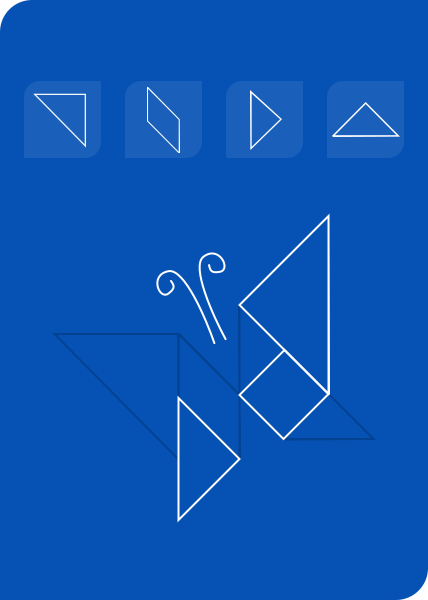
Digital Manipulatives give learners virtual hands-on tools for building understanding through repeated experimentation. Algebra tiles for equation solving, fraction bars for operations, base-ten blocks for place value, geometric construction tools, virtual microscopes, or statistical modeling tools, these digital versions offer advantages physical manipulatives can't: infinite supply, instant reset, embedded measurement, and progress tracking.
Practice & Mastery
REPETITION BUILDS FLUENCY, ENGAGEMENT SUSTAINS IT.
Practice activities turn procedural knowledge into automatic competence, but only if learners stay motivated through multiple attempts. Game-based practice and hands-on manipulation create the repetition learners need without the tedium traditional drill-and-practice often brings.
Learning Games wrap skill practice in compelling mechanics, points, levels, challenges, and rewards that keep learners coming back. Whether practicing arithmetic operations, vocabulary acquisition, grammar rules, or scientific classification, game structures provide immediate feedback and adaptive difficulty. We design games that balance entertainment with learning integrity, ensuring mechanics reinforce rather than distract from educational goals.
Digital Manipulatives give learners virtual hands-on tools for building understanding through repeated experimentation. Algebra tiles for equation solving, fraction bars for operations, base-ten blocks for place value, geometric construction tools, virtual microscopes, or statistical modeling tools, these digital versions offer advantages physical manipulatives can't: infinite supply, instant reset, embedded measurement, and progress tracking.

Learning Games wrap skill practice in compelling mechanics, points, levels, challenges, and rewards that keep learners coming back. Whether practicing arithmetic operations, vocabulary acquisition, grammar rules, or scientific classification, game structures provide immediate feedback and adaptive difficulty. We design games that balance entertainment with learning integrity, ensuring mechanics reinforce rather than distract from educational goals.
Digital Manipulatives give learners virtual hands-on tools for building understanding through repeated experimentation. Algebra tiles for equation solving, fraction bars for operations, base-ten blocks for place value, geometric construction tools, virtual microscopes, or statistical modeling tools, these digital versions offer advantages physical manipulatives can't: infinite supply, instant reset, embedded measurement, and progress tracking.
Real-World Application
KNOWLEDGE BECOMES MEANINGFUL WHEN STUDENTS USE IT.
Application experiences bridge classroom learning and authentic contexts, challenging learners to apply concepts in realistic situations where decisions have consequences. These activities develop critical thinking, professional judgment, and transferable skills that standardized assessments can't measure.
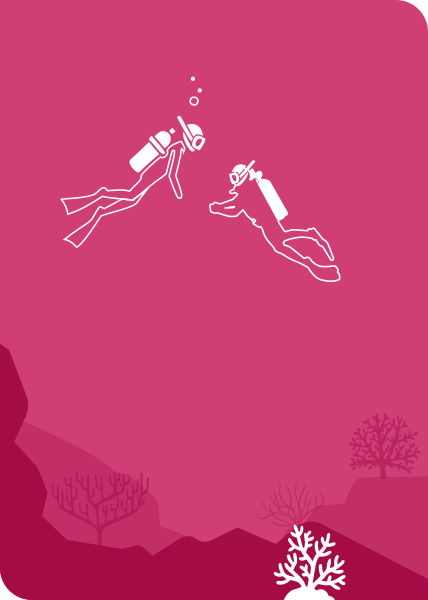
Simulation Activities place learners in realistic environments where they apply domain knowledge to achieve goals. Learners might manage a virtual business balancing revenue and expenses, conduct patient assessments in clinical scenarios, design sustainable cities considering environmental constraints, or troubleshoot electrical circuits. Simulations provide safe spaces for experimentation, letting learners learn mistakes without real-world consequences.
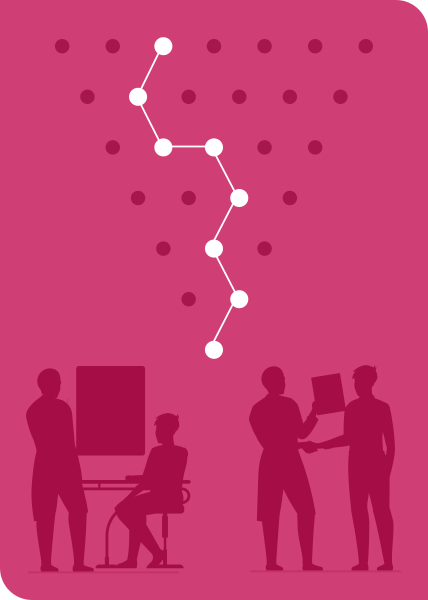
Scenario-Based Learning Activities present branching decision points where learner choices shape outcomes. A nursing learner assesses symptoms and chooses interventions, a business learner navigates workplace ethical dilemmas, a teacher candidate responds to classroom management situations-each decision reveals consequences and builds judgment. We design scenarios with multiple valid approaches, realistic complexity, and feedback that explains why choices lead to particular outcomes.
Real-World Application
KNOWLEDGE BECOMES MEANINGFUL WHEN STUDENTS USE IT.
Application experiences bridge classroom learning and authentic contexts, challenging learners to apply concepts in realistic situations where decisions have consequences. These activities develop critical thinking, professional judgment, and transferable skills that standardized assessments can't measure.
Simulation Activities place learners in realistic environments where they apply domain knowledge to achieve goals. Learners might manage a virtual business balancing revenue and expenses, conduct patient assessments in clinical scenarios, design sustainable cities considering environmental constraints, or troubleshoot electrical circuits. Simulations provide safe spaces for experimentation, letting learners learn mistakes without real-world consequences.
Scenario-Based Learning Activities present branching decision points where learner choices shape outcomes. A nursing learner assesses symptoms and chooses interventions, a business learner navigates workplace ethical dilemmas, a teacher candidate responds to classroom management situations-each decision reveals consequences and builds judgment. We design scenarios with multiple valid approaches, realistic complexity, and feedback that explains why choices lead to particular outcomes.

Simulation Activities place learners in realistic environments where they apply domain knowledge to achieve goals. Learners might manage a virtual business balancing revenue and expenses, conduct patient assessments in clinical scenarios, design sustainable cities considering environmental constraints, or troubleshoot electrical circuits. Simulations provide safe spaces for experimentation, letting learners learn mistakes without real-world consequences.
Scenario-Based Learning Activities present branching decision points where learner choices shape outcomes. A nursing learner assesses symptoms and chooses interventions, a business learner navigates workplace ethical dilemmas, a teacher candidate responds to classroom management situations-each decision reveals consequences and builds judgment. We design scenarios with multiple valid approaches, realistic complexity, and feedback that explains why choices lead to particular outcomes.